How do I know I’m talking to a predator online?
By Teen Health Source
Being online means connecting with people in ways you likely wouldn’t in real life. You might talk to someone who goes to a different school, someone who lives really far away, or someone that’s a different age than you. Maybe you meet them in a Discord channel for your favourite tv show, maybe you started chatting in a Twitch stream, or maybe they just found your Tiktok funny and reached out. Being online often means being accessible to a lot more people than you might be prepared for, and that includes people who might not have the best intentions in getting to know you.
When we talk about predatory behaviour, we usually mean people who communicate with the intention of harming someone else. In this post, we’ll talk about what that looks like in the context of trying to start inappropriate romantic or sexual relationships.
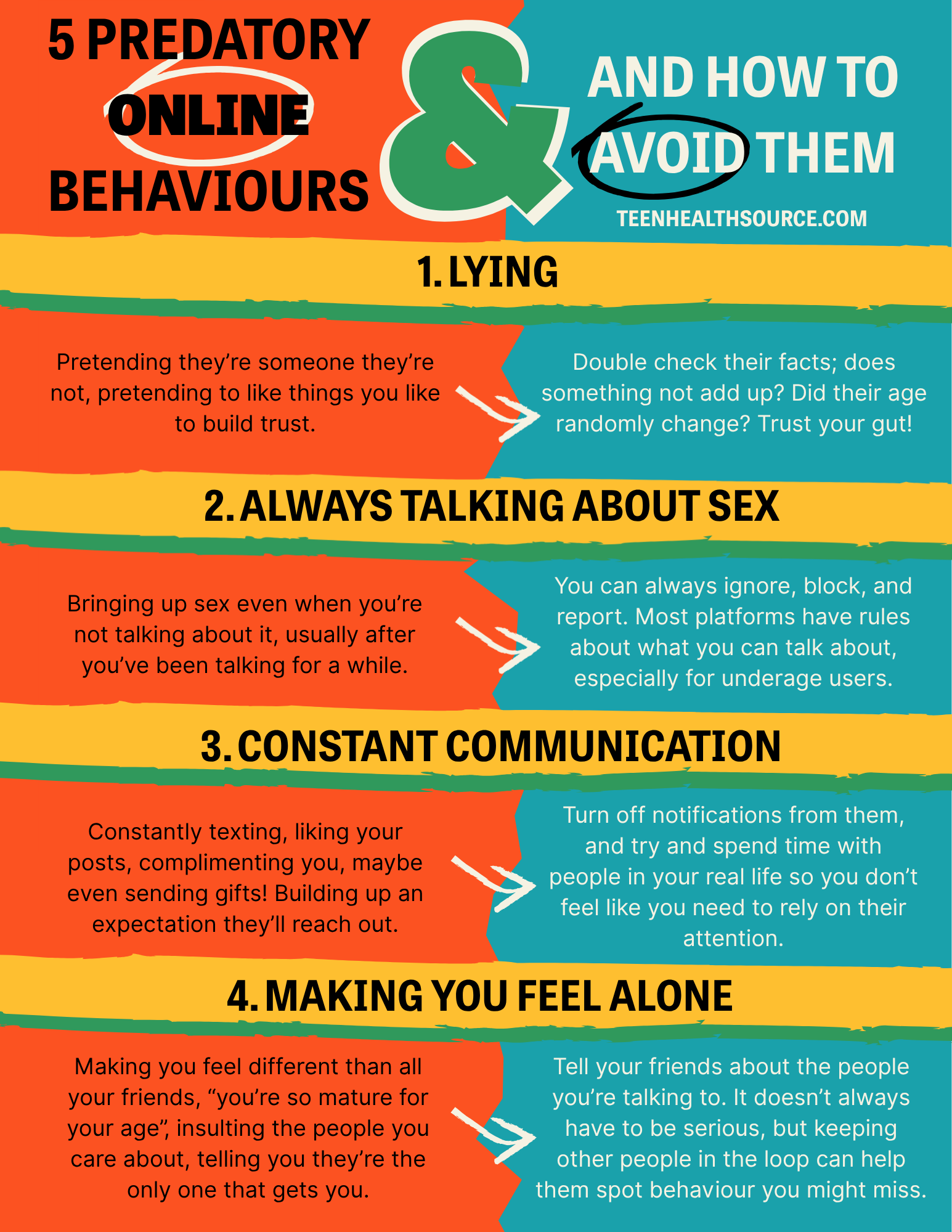
There are a few common red flags to look out for when it comes to spotting predatory behaviour:
-
- Lying: The most common strategy predators use to gain your trust is lying in some way or another. Usually they’re trying to make themselves out to be someone you’d want to spend time with–so someone close to your age, that knows people you know, or likes things you like. It can be hard to figure out what’s true just from online conversations, so you might have to pay close attention to details they share to make sure they’re consistent; did they say they graduated in a year that doesn’t make sense for how old they are? Did they get a really obvious name wrong? Did their age or location change over the course of your conversation (maybe they started by saying they’re 16, but then changed it to 18 at another point in the conversation)? Are they using slang or typing in a way that’s completely different from how you and your friends type? Trust your gut if something feels off!
- Shifting the conversation towards sex: Most conversations with predators don’t start off sexual. They might start friendly, or about something specific like a video game you both like. They might not even talk about sex directly for a long time until they feel like you have started to trust them. Eventually they might start asking one-off questions about your own sexual experiences, or your body, or things you like, or just start talking about their own experiences to see what you think. You don’t ever have to engage in a conversation you don’t feel comfortable with, and you don’t have to share anything about yourself that you don’t want to. If a conversation is feeling like it’s going in a direction you don’t like, you can ignore them, block them, report them, or all three!
- Constant communication: Predators make a point of constantly communicating with their victims to try and build a sense of dependency. Constantly messaging, liking, complimenting, giving you attention and showing interest in you are all ways that predators can build up a reliance on that attention to feel good about yourself. If you’ve ever heard the phrase “love-bombing” that’s kind of the idea–beginning the relationship by being overly nice, overly complimentary (maybe even sending you little gifts or money), to get you hooked and build an expectation of kindness that they won’t maintain or are specifically doing to get closer to you in an unhealthy way.
- Making you feel alone: Predators want you to feel like they’re the only one who gets you, and when you’re a teen, feeling misunderstood and powerless is a super common experience! You don’t get to meet the people you want to meet and you don’t get to make a lot of decisions for yourself even though you feel ready to–predators understand this and take advantage of it. Phrases like “you’re so mature for your age” or “honestly I feel like no one gets you like I do” are meant to make you feel more distant from the people in your life so that you feel like your relationship with them is the only one that matters. They might even start insulting the people in your life to make you turn away from them.
What to do if you believe you or someone you know is talking to a predator
- Reach out to someone: If you are unsure if you are in danger, KidsHelpPhone.Ca provides confidential and judge free help to minors. You can Text them at 686868 or call them at 1-800-668-6868.
- If you know that you or someone else is being harmed, harassed, or exploited, call the police or tell a trusted adult.
TL;DR
A lot of the time, predators will come across as friendly people just trying to get to know you. They might not even sound all that different than people you go to school with. It might feel exciting to get to know someone new, especially if they tell you they’re a little older–it makes sense you’d want to feel like you actually have control over something all your own! Unfortunately, relationships built this way tend to have pretty unhealthy power dynamics–they might have different expectations of you than someone your age, or not really be interested in caring for you in the way you’d hope. Like all relationships, talking through them with your friends or other people you know can be a helpful way to figure out if something weird is going on.
Further Reading
If you have questions about this topic, feel free to contact one of our peer educators. [Link]
Last Edited: July 2026
-
What’s up with withdrawal? People often feel guilty or nervous when they use it as a method of birth control, but does it actually work?
-

Volunteer with Teen Health Source!
-

Next Gen Men is a Canadian nonprofit who work to change how the world sees, acts and thinks about masculinity.